図? 割り込み処理の前半部分と後半部分
					2016年02月05日
情報科学類 オペレーティングシステム II

                                       筑波大学 システム情報系
                                       新城 靖
                                       <yas@cs.tsukuba.ac.jp>
このページは、次の URL にあります。
http://www.coins.tsukuba.ac.jp/~yas/coins/os2-2015/2016-02-05
あるいは、次のページから手繰っていくこともできます。
http://www.coins.tsukuba.ac.jp/~yas/
http://www.cs.tsukuba.ac.jp/~yas/
試験について
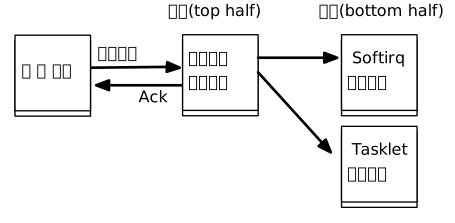
図? 割り込み処理の前半部分と後半部分
割り込みハンドラ(前半部)と後半部の役割分担の目安。
注意1: Tasklet は、task 構造体とはまったく関係ない。名前がよくない。
注意2: Softirq という用語を、割り込み処理の後半部という意味で使う人もい る。
注意3: 伝統的なUnixでは、top half は、システム・コールから派生する上位 層の処理、bottom half は、割り込みから派生する下位層の処理の意味で使わ れることがある。Linux では、top half, bottom half は、割り込み処理の前 半部分と後半部分の意味に使う。
Tasklet で1つの仕事は次のような、struct tasklet_struct で表現される。
linux-3.18.1/include/linux/interrupt.h
 465:	struct tasklet_struct
 466:	{
 467:	        struct tasklet_struct *next;
 468:	        unsigned long state;
 469:	        atomic_t count;
 470:	        void (*func)(unsigned long);
 471:	        unsigned long data;
 472:	};
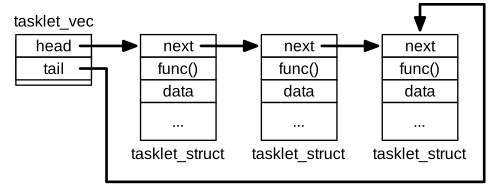
図? Taskletにおける仕事のキュー
DECLARE_TASKLET(name, func, data)
    有効な(count==0) の struct tasklet_struct を宣言する

DECLARE_TASKLET_DISABLED(name, func, data)
    無効な(count==1) の struct tasklet_struct を宣言する
void tasklet_init(struct tasklet_struct *t,
    void (*func)(unsigned long), unsigned long data);
その他に、生成消滅有効無効に関して次のような操作がある。
void tasklet_handler(unsigned long data) {
    ...
}
void tasklet_schedule(struct tasklet_struct *t)
    Tasklet t を通常の優先度でスケジュールする

void tasklet_hi_schedule(struct tasklet_struct *t)
    Tasklet t を高優先度でスケジュールする
すると、それは「そのうちに」1度だけ実行される。
linux-4.3.3/drivers/net/wireless/ath/ath9k/ath9k.h
 954:	struct ath_softc {
...
 961:	        struct tasklet_struct intr_tq;
 962:	        struct tasklet_struct bcon_tasklet;
...
1042:	};

linux-4.3.3/drivers/net/wireless/ath/ath9k/init.c
 532:	static int ath9k_init_softc(u16 devid, struct ath_softc *sc,
 533:	                            const struct ath_bus_ops *bus_ops)
 534:	{
...
 619:	        tasklet_init(&sc->intr_tq, ath9k_tasklet, (unsigned long)sc);
 620:	        tasklet_init(&sc->bcon_tasklet, ath9k_beacon_tasklet,
 621:	                     (unsigned long)sc);
...
 682:	}
linux-4.3.3/drivers/net/wireless/ath/ath9k/main.c

 486:	irqreturn_t ath_isr(int irq, void *dev)
 487:	{
...
 504:	        struct ath_softc *sc = dev;
...
 507:	        enum ath9k_int status;
...
 509:	        bool sched = false;
...
 529:	        ath9k_hw_getisr(ah, &status, &sync_cause); /* NB: clears ISR too */
...
 546:	        if (status & SCHED_INTR)
 547:	                sched = true;
...
 560:	        if (status & ATH9K_INT_SWBA)
 561:	                tasklet_schedule(&sc->bcon_tasklet);
...
 588:	        if (sched) {
 589:	                /* turn off every interrupt */
 590:	                ath9k_hw_disable_interrupts(ah);
 591:	                tasklet_schedule(&sc->intr_tq);
 592:	        }
 593:
 594:	        return IRQ_HANDLED;
...
 597:	}

 369:	void ath9k_tasklet(unsigned long data)
 370:	{
...
 484:	}

linux-4.3.3/drivers/net/wireless/ath/ath9k/beacon.c
 319:	void ath9k_beacon_tasklet(unsigned long data)
 320:	{
...
 439:	}
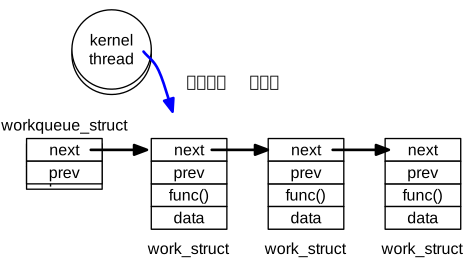
図? Work Queueにおける仕事のキュー
キューにつながれる仕事は、Tasklet の仕事とほとんど同じで、関数へのポイ ンタ func と data からなる。処理の主体が、ワーカ・スレッドと呼ばれるカー ネル・レベルのスレッドである所が違う。
$ ps alx|egrep events ![[←]](../icons/screen-return.gif) 1 0 19 2 20 0 0 0 worker S ? 0:12 [events/0]
1 0 20 2 20 0 0 0 worker S ? 0:08 [events/1]
1 0 21 2 20 0 0 0 worker S ? 0:08 [events/2]
1 0 22 2 20 0 0 0 worker S ? 0:10 [events/3]
0 1013 3242 2450 20 0 105236 900 pipe_w S+ pts/3 0:00 egrep events
$
1 0 19 2 20 0 0 0 worker S ? 0:12 [events/0]
1 0 20 2 20 0 0 0 worker S ? 0:08 [events/1]
1 0 21 2 20 0 0 0 worker S ? 0:08 [events/2]
1 0 22 2 20 0 0 0 worker S ? 0:10 [events/3]
0 1013 3242 2450 20 0 105236 900 pipe_w S+ pts/3 0:00 egrep events
$ ![[]](../icons/screen-cursor.gif)
汎用の Work Queue のワーカ・スレッドの他に、専用のワーカ・スレッドを作
ることもできる。
linux-4.3.3/include/linux/workqueue.h
  19:	typedef void (*work_func_t)(struct work_struct *work);

 100:	struct work_struct {
 101:	        atomic_long_t data;
 102:	        struct list_head entry;
 103:	        work_func_t func;
...
 107:	};
struct work_struct my_work;
...
INIT_WORK(&my_work,my_work_handler);
void my_work_handler(struct work_struct *work)
{
...
}
schedule_work(&work);
この結果、INIT_WORK() で設定したハンドラがワーカ・スレッドにより「その
うち」に呼び出される。
schedule_work() では、即座に実行される可能性もある。少し後に実行したい (間を取りたい)時には、次の関数を呼ぶ。
schedule_delayed_work(&work,ticks);
ticks は、どのくらい間をとるか。単位は、
ticks (jiffiesの単位)。
多くのシステムで10ミリ秒-1ミリ秒で、設定によって異なる。
解決策:
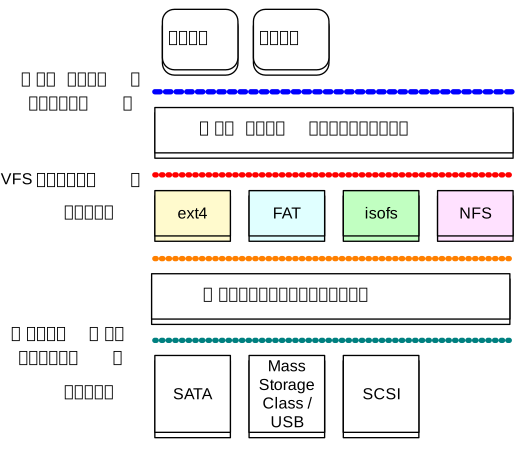
図? 層構造を用いたファイル・システムの実装
解決策
$ ls -l /usr/bin/{perl,perl5.10.1}
-rwxr-xr-x. 2 root root 13304 Nov 12 18:11 /usr/bin/perl
-rwxr-xr-x. 2 root root 13304 Nov 12 18:11 /usr/bin/perl5.10.1
$ ls -li /usr/bin/{perl,perl5.10.1}
1837781 -rwxr-xr-x. 2 root root 13304 Nov 12 18:11 /usr/bin/perl
1837781 -rwxr-xr-x. 2 root root 13304 Nov 12 18:11 /usr/bin/perl5.10.1
$
$ grep -v '#' /etc/fstab

UUID=9cfbc67e-781c-48d1-8303-1dde8ce87ee9 /                       ext4    defaults        1 1
UUID=bab1faf1-5f5b-4a2a-b24f-e850a2b0b82d /boot                   ext4    defaults        1 2
UUID=a1f61ff2-2c99-4c54-8c3e-2178eed3ec10 swap                    swap    defaults        0 0
tmpfs                   /dev/shm                tmpfs   defaults        0 0
devpts                  /dev/pts                devpts  gid=5,mode=620  0 0
sysfs                   /sys                    sysfs   defaults        0 0
proc                    /proc                   proc    defaults        0 0
pentas-fs:/vol0/home   /home        nfs     rw,hard,bg,nfsvers=3,intr 0 0
pentas-fs:/vol0/web    /var/www     nfs     rw,hard,bg,nfsvers=3,intr 0 0
pentas-fs:/vol0/local3 /
$ df /
Filesystem     1K-blocks    Used Available Use% Mounted on
/dev/sda3       49071944 6721604  39857568  15% /
$ blkid /dev/sda3
/dev/sda3: UUID="9cfbc67e-781c-48d1-8303-1dde8ce87ee9" TYPE="ext4"
$ ls -l /dev/sda3
brw-rw----. 1 root disk 8, 3 Feb  2 10:50 /dev/sda3
$ lsblk
NAME   MAJ:MIN RM  SIZE RO TYPE MOUNTPOINT
sda      8:0    0   50G  0 disk
|-sda1   8:1    0  512M  0 part /boot
|-sda2   8:2    0    2G  0 part [SWAP]
`-sda3   8:3    0 47.6G  0 part /
sr0     11:0    1 1024M  0 rom
$ ls -l /dev/sda
brw-rw----. 1 root disk 8, 0 Feb  2 10:50 /dev/sda
$
$ grep cd /etc/auto.misc
cd              -fstype=iso9660,ro,nosuid,nodev :/dev/cdrom
$
STAT(2)                    Linux Programmer's Manual                   STAT(2)
...
       int stat(const char *path, struct stat *buf);
...
          struct stat {
              dev_t     st_dev;     /* ID of device containing file */
              ino_t     st_ino;     /* inode number */
              mode_t    st_mode;    /* protection */
              nlink_t   st_nlink;   /* number of hard links */
              uid_t     st_uid;     /* user ID of owner */
              gid_t     st_gid;     /* group ID of owner */
              dev_t     st_rdev;    /* device ID (if special file) */
              off_t     st_size;    /* total size, in bytes */
              blksize_t st_blksize; /* blocksize for filesystem I/O */
              blkcnt_t  st_blocks;  /* number of blocks allocated */
              time_t    st_atime;   /* time of last access */
              time_t    st_mtime;   /* time of last modification */
              time_t    st_ctime;   /* time of last status change */
          };
stat コマンドを使うと stat システム・コールで返される値に近いものが表示
される。
$ ls -l .bashrc
-rw-r--r--. 1 yas prof 241 Jun 19  2015 .bashrc
$ stat .bashrc
  File: `.bashrc'
  Size: 241             Blocks: 16         IO Block: 65536  regular file
Device: 13h/19d Inode: 29988667    Links: 1
Access: (0644/-rw-r--r--)  Uid: ( 1013/     yas)   Gid: (  510/    prof)
Access: 2016-01-31 15:25:29.000000000 +0900
Modify: 2015-06-19 10:40:12.000860000 +0900
Change: 2016-01-30 16:39:59.001034000 +0900
$
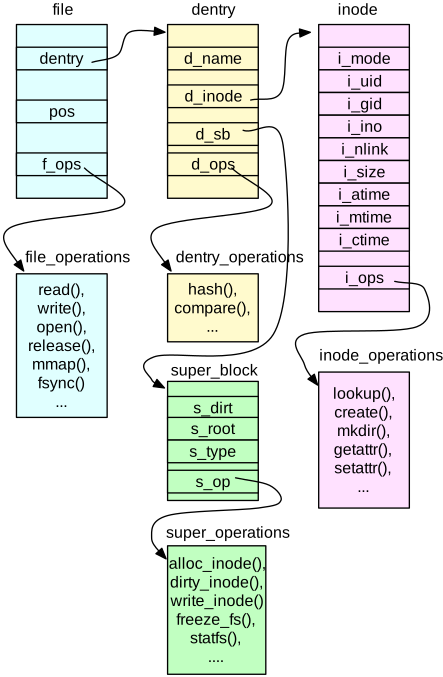
図? スーパーブロック、inode、dentry、file
    int fd1 = open("file1",O_RDONLY);
    int fd2 = open("file1",O_RDONLY);
ファイル名 "file1" で表現されるファイルの inode 構造体は、1 個でも、
file 構造体は、2 個割り当てられる。
ディスク上には対応するデータ構造は存在しない。
linux-4.3.3/include/linux/fs.h

 839:	struct file {
...
 844:	        struct path             f_path;
 845:	        struct inode            *f_inode;       /* cached value */
 846:	        const struct file_operations    *f_op;
...
 853:	        atomic_long_t           f_count;
...
 855:	        fmode_t                 f_mode;
...
 857:	        loff_t                  f_pos;
...
 867:	        void                    *private_data;
...
 874:	        struct address_space    *f_mapping;
 875:	} __attribute__((aligned(4)));  /* lest something weird decides that 2 is OK */
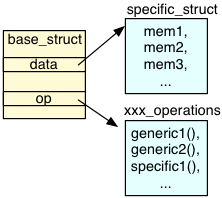
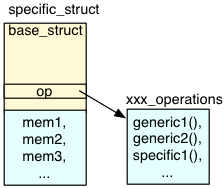
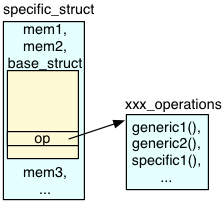
図? C言語によるオブジェクト指向の継承の実装方法。共通インスタンス変数・関数、固有インスタンス変数関数の置き方
struct fileの操作は、たとえば次のような形で行われる。 第1引数は、struct file *。
    struct file *file;
    file->f_op->read(file, buf, count, pos);
f_op には、次のような手続きがある。各ファイルシステム
(ext4,nfs,tmpfs,...) ごとに、手続きの実体は異なるが、インタフェースは同じ。
linux-4.3.3/include/linux/fs.h

1613:	struct file_operations {
1614:	        struct module *owner;
1615:	        loff_t (*llseek) (struct file *, loff_t, int);
1616:	        ssize_t (*read) (struct file *, char __user *, size_t, loff_t *);
1617:	        ssize_t (*write) (struct file *, const char __user *, size_t, loff_t *);
1618:	        ssize_t (*read_iter) (struct kiocb *, struct iov_iter *);
1619:	        ssize_t (*write_iter) (struct kiocb *, struct iov_iter *);
1620:	        int (*iterate) (struct file *, struct dir_context *);
1621:	        unsigned int (*poll) (struct file *, struct poll_table_struct *);
1622:	        long (*unlocked_ioctl) (struct file *, unsigned int, unsigned long);
1623:	        long (*compat_ioctl) (struct file *, unsigned int, unsigned long);
1624:	        int (*mmap) (struct file *, struct vm_area_struct *);
1625:	        int (*open) (struct inode *, struct file *);
1626:	        int (*flush) (struct file *, fl_owner_t id);
1627:	        int (*release) (struct inode *, struct file *);
1628:	        int (*fsync) (struct file *, loff_t, loff_t, int datasync);
1629:	        int (*aio_fsync) (struct kiocb *, int datasync);
1630:	        int (*fasync) (int, struct file *, int);
1631:	        int (*lock) (struct file *, int, struct file_lock *);
1632:	        ssize_t (*sendpage) (struct file *, struct page *, int, size_t, loff_t *, int);
1633:	        unsigned long (*get_unmapped_area)(struct file *, unsigned long, unsigned long, unsigned long, unsigned long);
1634:	        int (*check_flags)(int);
1635:	        int (*flock) (struct file *, int, struct file_lock *);
1636:	        ssize_t (*splice_write)(struct pipe_inode_info *, struct file *, loff_t *, size_t, unsigned int);
1637:	        ssize_t (*splice_read)(struct file *, loff_t *, struct pipe_inode_info *, size_t, unsigned int);
1638:	        int (*setlease)(struct file *, long, struct file_lock **, void **);
1639:	        long (*fallocate)(struct file *file, int mode, loff_t offset,
1640:	                          loff_t len);
1641:	        void (*show_fdinfo)(struct seq_file *m, struct file *f);
1642:	#ifndef CONFIG_MMU
1643:	        unsigned (*mmap_capabilities)(struct file *);
1644:	#endif
1645:	};
主な手続きの意味
linux-4.3.3/include/linux/dcache.h
 108:	struct dentry {
...
 113:	        struct dentry *d_parent;        /* parent directory */
 114:	        struct qstr d_name;
 115:	        struct inode *d_inode;          /* Where the name belongs to - NULL is
 116:	                                         * negative */
 117:	        unsigned char d_iname[DNAME_INLINE_LEN];        /* small names */
...
 120:	        struct lockref d_lockref;       /* per-dentry lock and refcount */
 121:	        const struct dentry_operations *d_op;
 122:	        struct super_block *d_sb;       /* The root of the dentry tree */
...
 124:	        void *d_fsdata;                 /* fs-specific data */
...
 127:	        struct list_head d_child;       /* child of parent list */
 128:	        struct list_head d_subdirs;     /* our children */
...
 136:	};

 322:	static inline unsigned d_count(const struct dentry *dentry)
 323:	{
 324:	        return dentry->d_lockref.count;
 325:	}
 326:

  30:	 #define HASH_LEN_DECLARE u32 hash; u32 len;

  44:	struct qstr {
...
  47:	                        HASH_LEN_DECLARE;
...
  51:	        const unsigned char *name;
  52:	};

 102:	#  define DNAME_INLINE_LEN 40 /* 128 bytes */
linux-4.3.3/include/linux/fs.h
 584:	struct inode {
 585:	        umode_t                 i_mode;
 586:	        unsigned short          i_opflags;
 587:	        kuid_t                  i_uid;
 588:	        kgid_t                  i_gid;
...
 596:	        const struct inode_operations   *i_op;
 597:	        struct super_block      *i_sb;
...
 605:	        unsigned long           i_ino;
...
 617:	        dev_t                   i_rdev;
 618:	        loff_t                  i_size;
 619:	        struct timespec         i_atime;
 620:	        struct timespec         i_mtime;
 621:	        struct timespec         i_ctime;
 622:	        spinlock_t              i_lock; /* i_blocks, i_bytes, maybe i_size */
 623:	        unsigned short          i_bytes;
 624:	        unsigned int            i_blkbits;
 625:	        blkcnt_t                i_blocks;
...
 632:	        unsigned long           i_state;
...
 638:	        struct hlist_node       i_hash;
...
 651:	                struct hlist_head       i_dentry;
...
 655:	        atomic_t                i_count;
...
 679:	        void                    *i_private; /* fs or device private pointer */
 680:	};
    struct inode *inode;
    ...
    inode->i_op->create(inode, name, mode, true);
i_op には、次のような手続きがある。各ファイルシステム
(ext4,nfs,tmpfs,...) ごとに、手続きの実体は異なるが、インタフェースは同じ。
linux-4.3.3/include/linux/fs.h
1647:	struct inode_operations {
1648:	        struct dentry * (*lookup) (struct inode *,struct dentry *, unsigned int);
1649:	        const char * (*follow_link) (struct dentry *, void **);
1650:	        int (*permission) (struct inode *, int);
1651:	        struct posix_acl * (*get_acl)(struct inode *, int);
1652:
1653:	        int (*readlink) (struct dentry *, char __user *,int);
1654:	        void (*put_link) (struct inode *, void *);
1655:
1656:	        int (*create) (struct inode *,struct dentry *, umode_t, bool);
1657:	        int (*link) (struct dentry *,struct inode *,struct dentry *);
1658:	        int (*unlink) (struct inode *,struct dentry *);
1659:	        int (*symlink) (struct inode *,struct dentry *,const char *);
1660:	        int (*mkdir) (struct inode *,struct dentry *,umode_t);
1661:	        int (*rmdir) (struct inode *,struct dentry *);
1662:	        int (*mknod) (struct inode *,struct dentry *,umode_t,dev_t);
1663:	        int (*rename) (struct inode *, struct dentry *,
1664:	                        struct inode *, struct dentry *);
1665:	        int (*rename2) (struct inode *, struct dentry *,
1666:	                        struct inode *, struct dentry *, unsigned int);
1667:	        int (*setattr) (struct dentry *, struct iattr *);
1668:	        int (*getattr) (struct vfsmount *mnt, struct dentry *, struct kstat *);
1669:	        int (*setxattr) (struct dentry *, const char *,const void *,size_t,int);
1670:	        ssize_t (*getxattr) (struct dentry *, const char *, void *, size_t);
1671:	        ssize_t (*listxattr) (struct dentry *, char *, size_t);
1672:	        int (*removexattr) (struct dentry *, const char *);
1673:	        int (*fiemap)(struct inode *, struct fiemap_extent_info *, u64 start,
1674:	                      u64 len);
1675:	        int (*update_time)(struct inode *, struct timespec *, int);
1676:	        int (*atomic_open)(struct inode *, struct dentry *,
1677:	                           struct file *, unsigned open_flag,
1678:	                           umode_t create_mode, int *opened);
1679:	        int (*tmpfile) (struct inode *, struct dentry *, umode_t);
1680:	        int (*set_acl)(struct inode *, struct posix_acl *, int);
1681:
1682:	        /* WARNING: probably going away soon, do not use! */
1683:	} ____cacheline_aligned;
linux-4.3.3/include/linux/fs.h
1289:	struct super_block {
...
1294:	        loff_t                  s_maxbytes;     /* Max file size */
1295:	        struct file_system_type *s_type;
1296:	        const struct super_operations   *s_op;
...
1303:	        struct dentry           *s_root;
...
1326:	        void                    *s_fs_info;     /* Filesystem private info */
...
1374:	        struct list_lru         s_dentry_lru ____cacheline_aligned_in_smp;
1375:	        struct list_lru         s_inode_lru ____cacheline_aligned_in_smp;
...
1388:	        struct list_head        s_inodes;       /* all inodes */
1389:	};
p->files->fd_array[fd] の struct file を表
す。
linux-4.3.3/include/linux/sched.h
1378:	struct task_struct {
...
1560:	        struct files_struct *files;
...
1823:	};

linux-4.3.3/include/linux/fdtable.h
  45:	struct files_struct {
...
  62:	        struct file __rcu * fd_array[NR_OPEN_DEFAULT];
  63:	};
  22:	#define NR_OPEN_DEFAULT BITS_PER_LONG

linux-4.3.3/include/asm-generic/bitsperlong.h
   7:	#ifdef CONFIG_64BIT
   8:	#define BITS_PER_LONG 64
   9:	#else
  10:	#define BITS_PER_LONG 32
  11:	#endif /* CONFIG_64BIT */
![図? p->files->fd_array[fd]](images/task-files-file-dentry-inode.svg)
図? task_struct、ファイル記述子、file構造体、その他
linux-4.3.3/fs/read_write.c
 562:	SYSCALL_DEFINE3(read, unsigned int, fd, char __user *, buf, size_t, count)
 563:	{
 564:	        struct fd f = fdget_pos(fd);
 565:	        ssize_t ret = -EBADF;
 566:
 567:	        if (f.file) {
 568:	                loff_t pos = file_pos_read(f.file);
 569:	                ret = vfs_read(f.file, buf, count, &pos);
 570:	                if (ret >= 0)
 571:	                        file_pos_write(f.file, pos);
 572:	                fdput_pos(f);
 573:	        }
 574:	        return ret;
 575:	}

linux-4.3.3/include/linux/file.h
  29:	struct fd {
  30:	        struct file *file;
  31:	        unsigned int flags;
  32:	};
linux-4.3.3/fs/read_write.c

 440:	ssize_t vfs_read(struct file *file, char __user *buf, size_t count, loff_t *pos)
 441:	{
 442:	        ssize_t ret;
 443:
 444:	        if (!(file->f_mode & FMODE_READ))
 445:	                return -EBADF;
 446:	        if (!(file->f_mode & FMODE_CAN_READ))
 447:	                return -EINVAL;
 448:	        if (unlikely(!access_ok(VERIFY_WRITE, buf, count)))
 449:	                return -EFAULT;
 450:
 451:	        ret = rw_verify_area(READ, file, pos, count);
 452:	        if (ret >= 0) {
 453:	                count = ret;
 454:	                ret = __vfs_read(file, buf, count, pos);
 455:	                if (ret > 0) {
 456:	                        fsnotify_access(file);
 457:	                        add_rchar(current, ret);
 458:	                }
 459:	                inc_syscr(current);
 460:	        }
 461:
 462:	        return ret;
 463:	}
linux-4.3.3/fs/ext4/file.c
 696:	const struct file_operations ext4_file_operations = {
 697:	        .llseek         = ext4_llseek,
 698:	        .read_iter      = generic_file_read_iter,
 699:	        .write_iter     = ext4_file_write_iter,
 700:	        .unlocked_ioctl = ext4_ioctl,
 701:	#ifdef CONFIG_COMPAT
 702:	        .compat_ioctl   = ext4_compat_ioctl,
 703:	#endif
 704:	        .mmap           = ext4_file_mmap,
 705:	        .open           = ext4_file_open,
 706:	        .release        = ext4_release_file,
 707:	        .fsync          = ext4_sync_file,
 708:	        .splice_read    = generic_file_splice_read,
 709:	        .splice_write   = iter_file_splice_write,
 710:	        .fallocate      = ext4_fallocate,
 711:	};

 713:	const struct inode_operations ext4_file_inode_operations = {
...
 723:	};

linux-4.3.3/fs/ext4/super.c
1121:	static const struct super_operations ext4_sops = {
...
1141:	};
linux-4.3.3/fs/ext4/ext4.h
 814:	struct ext4_inode_info {
...
 872:	        struct inode vfs_inode;
...
 955:	};

1378:	static inline struct ext4_inode_info *EXT4_I(struct inode *inode)
1379:	{
1380:	        return container_of(inode, struct ext4_inode_info, vfs_inode);
1381:	}

linux-4.3.3/include/linux/kernel.h
 803:	/**
 804:	 * container_of - cast a member of a structure out to the containing structure
 805:	 * @ptr:        the pointer to the member.
 806:	 * @type:       the type of the container struct this is embedded in.
 807:	 * @member:     the name of the member within the struct.
 808:	 *
 809:	 */
 810:	#define container_of(ptr, type, member) ({                      \
 811:	        const typeof( ((type *)0)->member ) *__mptr = (ptr);    \
 812:	        (type *)( (char *)__mptr - offsetof(type,member) );})
 813:
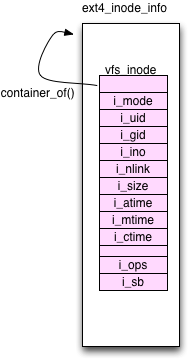
図? Ext4 ファイルシステムで使う構造体 ext4_inode_info での struct inode の保持
linux-4.3.3/mm/filemap.c
1714:	ssize_t
1715:	generic_file_read_iter(struct kiocb *iocb, struct iov_iter *iter)
1716:	{
1717:	        struct file *file = iocb->ki_filp;
1718:	        ssize_t retval = 0;
1719:	        loff_t *ppos = &iocb->ki_pos;
1720:	        loff_t pos = *ppos;
...
1758:
1759:	        retval = do_generic_file_read(file, ppos, iter, retval);
1760:	out:
1761:	        return retval;
1762:	}
linux-4.3.3/mm/filemap.c
1487:	static ssize_t do_generic_file_read(struct file *filp, loff_t *ppos,
1488:	                struct iov_iter *iter, ssize_t written)
1489:	{
1490:	        struct address_space *mapping = filp->f_mapping;
1491:	        struct inode *inode = mapping->host;
...
1493:	        pgoff_t index;
...
1496:	        unsigned long offset;      /* offset into pagecache page */
...
1498:	        int error = 0;
...
1500:	        index = *ppos >> PAGE_CACHE_SHIFT;
...
1504:	        offset = *ppos & ~PAGE_CACHE_MASK;
...
1506:	        for (;;) {
1507:	                struct page *page;
...
1510:	                unsigned long nr, ret;
...
1514:	                page = find_get_page(mapping, index);
1515:	                if (!page) {
1516:	                        page_cache_sync_readahead(mapping,
1517:	                                        ra, filp,
1518:	                                        index, last_index - index);
1519:	                        page = find_get_page(mapping, index);
...
1522:	                }
...
1559:	                /* nr is the maximum number of bytes to copy from this page */
1560:	                nr = PAGE_CACHE_SIZE;
...
1568:	                nr = nr - offset;
...
1590:	                ret = copy_page_to_iter(page, offset, nr, iter);
1591:	                offset += ret;
1592:	                index += offset >> PAGE_CACHE_SHIFT;
1593:	                offset &= ~PAGE_CACHE_MASK;
...
1596:	                page_cache_release(page);
1597:	                written += ret;
1598:	                if (!iov_iter_count(iter))
1599:	                        goto out;
...
1604:	                continue;
...
1694:	        }
1695:
1696:	out:
1701:	        *ppos = ((loff_t)index << PAGE_CACHE_SHIFT) + offset;
1702:	        file_accessed(filp);
1703:	        return written ? written : error;
1704:	}
void f(int arg1, int arg2) {
   省略;
}
これを実現するために、どのような Tasklet のハンドラと初期化コードを書け
ばよいか。以下の空欄を埋めなさい。
void tasklet_handler(unsigned long data) { /* Tasklet ハンドラ */
    int arg1, arg2;
    arg1 = 省略;
    arg2 = 省略;
    /*空欄(a)*/
    その他の仕事;
}

DECLARE_TASKLET(/*空欄(b)*/, /*空欄(c)*/, 0); /* 構造体の初期化 */
注意: 構造体の名前は、次の問題の解答で利用する。それらしいものを付けな
さい。
irqreturn_t irq_handler(int irq, void *dev) {
    /*空欄(d)*/
    return IRQ_HANDLED;
}
int vfs_fsync_range(struct file *file, loff_t start, loff_t end, int datasync)
{
	struct inode *inode = file->f_mapping->host;

	if (!file->f_op->/*空欄(e)*/)
		return -EINVAL;
	/*中略*/
	return file->f_op->/*空欄(f)*/(/*空欄(g)*/, start, end, datasync);
}