![[←]](../icons/screen-return.gif) cc gettimeofday-print.c -o gettimeofday-print
$ ./gettimeofday-print
Wed Jan 27 22:38:15 2016
$ date
Wed Jan 27 22:38:17 JST 2016
$
cc gettimeofday-print.c -o gettimeofday-print
$ ./gettimeofday-print
Wed Jan 27 22:38:15 2016
$ date
Wed Jan 27 22:38:17 JST 2016
$ ![[]](../icons/screen-cursor.gif)
					2016年01月29日
情報科学類 オペレーティングシステム II

                                       筑波大学 システム情報系
                                       新城 靖
                                       <yas@cs.tsukuba.ac.jp>
このページは、次の URL にあります。
http://www.coins.tsukuba.ac.jp/~yas/coins/os2-2015/2016-01-29
あるいは、次のページから手繰っていくこともできます。
http://www.coins.tsukuba.ac.jp/~yas/
http://www.cs.tsukuba.ac.jp/~yas/
struct timeval {
    time_t      tv_sec;     /* seconds. long int */
    suseconds_t tv_usec;    /* microseconds. long int */
};

int gettimeofday(struct timeval *tp, struct timezone *tzp);
int settimeofday(const struct timeval *tp, const struct timezone *tzp);
使い方
   1:	/*
   2:	        gettimeofday-print.c -- get colander time and print
   3:	        Created on: 2014/01/22 20:40:34
   4:	*/
   5:
   6:	#include <sys/time.h>   /* gettimeofday() */
   7:	#include <time.h>       /* ctime() */
   8:	#include <stdio.h>
   9:
  10:	main()
  11:	{
  12:	    struct timeval tv;
  13:	    time_t sec;
  14:	        gettimeofday( &tv, NULL );
  15:	        sec = tv.tv_sec;
  16:	        printf("%s", ctime(&sec) );
  17:	}
$ make gettimeofday-print
cc     gettimeofday-print.c   -o gettimeofday-print
$ ./gettimeofday-print
Wed Jan 27 22:38:15 2016
$ date
Wed Jan 27 22:38:17 JST 2016
$
POSIX 1003.1, 2003 の
struct timespec
では、ナノ秒単位。
struct timespec  {
    time_t tv_sec;            /* Seconds.  */
    long int tv_nsec;         /* Nanoseconds.  */
};

int clock_settime(clockid_t clock_id, const struct timespec *tp);
int clock_gettime(clockid_t clock_id, struct timespec *tp);
int clock_getres(clockid_t clock_id, struct timespec *res);
clock_id としては、CLOCK_REALTIME (カレンダ時刻)やCLOCK_MONOTONIC があ
る。
カレンダ時刻は、変更できる。逆走させることも可能。
順方向のジャンプや逆走を避けて、カレンダ時刻を合わせるには、adjtime() を使う。
int adjtime(const struct timeval *delta, struct timeval *olddelta);
struct itimerval {
    struct timeval it_interval; /* next value */
    struct timeval it_value;    /* current value */
};

int setitimer(int which, const struct itimerval *value,
    struct itimerval *ovalue);
int  select(int nfds, fd_set *readfds, fd_set *writefds, fd_set *exceptfds,
     		struct timeval *timeout);
int  poll(struct pollfd *fds, nfds_t nfds, int timeout);
ネットワーク・プログラムでよく使う。複数の入力を監視する。指定された時
間、入力がなければ、システム・コールから復帰する。
なにもしない時間切れ。
unsigned int sleep(unsigned int seconds);
int usleep(useconds_t usec)
int nanosleep(const struct timespec *rqtp, struct timespec *rmtp);
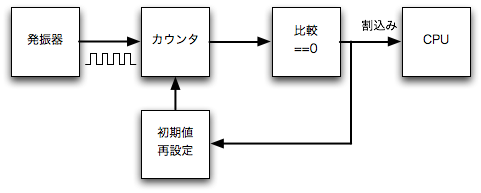
図? タイマ関連のハードウェアの基本モデル
2つの機能がある。
その他の割込み
linux-4.3.3/include/asm-generic/param.h
   7:	# define HZ             CONFIG_HZ       /* Internal kernel timer frequency */

linux-4.3.3/include/generated/autoconf.h
 816:	#define CONFIG_HZ 1000

linux-4.3.3/kernel/time/timer.c
  57:	__visible u64 jiffies_64 __cacheline_aligned_in_smp = INITIAL_JIFFIES;

linux-4.3.3/include/linux/jiffies.h
  77:	extern u64 __jiffy_data jiffies_64;
  78:	extern unsigned long volatile __jiffy_data jiffies;
linux-4.3.3/kernel/time/tick-common.c
  79:	static void tick_periodic(int cpu)
  80:	{
  81:	        if (tick_do_timer_cpu == cpu) {
...
  87:	                do_timer(1);
...
  89:	                update_wall_time();
  90:	        }
...
  92:	        update_process_times(user_mode(get_irq_regs()));
  94:	}
linux-4.3.3/kernel/time/timer.c
  57:	__visible u64 jiffies_64 __cacheline_aligned_in_smp = INITIAL_JIFFIES;

linux-4.3.3/kernel/time/timekeeping.c
1922:	void do_timer(unsigned long ticks)
1923:	{
1924:	        jiffies_64 += ticks;
...
1926:	}
xtime_nsec >> shift でナノ秒を表す。
linux-4.3.3/include/linux/timekeeper_internal.h
  30:	struct tk_read_base {
...
  36:	        u32                     shift;
  37:	        u64                     xtime_nsec;
...
  39:	};
...
  83:	struct timekeeper {
  84:	        struct tk_read_base     tkr_mono;
...
  86:	        u64                     xtime_sec;
...
 126:	};

linux-4.3.3/kernel/time/timekeeping.c
  75:	static inline struct timespec64 tk_xtime(struct timekeeper *tk)
  76:	{
  77:	        struct timespec64 ts;
  78:
  79:	        ts.tv_sec = tk->xtime_sec;
  80:	        ts.tv_nsec = (long)(tk->tkr_mono.xtime_nsec >> tk->tkr_mono.shift);
  81:	        return ts;
  82:	}
linux-4.3.3/kernel/time/time.c
 102:	SYSCALL_DEFINE2(gettimeofday, struct timeval __user *, tv,
 103:	                struct timezone __user *, tz)
 104:	{
 105:	        if (likely(tv != NULL)) {
 106:	                struct timeval ktv;
 107:	                do_gettimeofday(&ktv);
 108:	                if (copy_to_user(tv, &ktv, sizeof(ktv)))
 109:	                        return -EFAULT;
 110:	        }
 111:	        if (unlikely(tz != NULL)) {
 112:	                if (copy_to_user(tz, &sys_tz, sizeof(sys_tz)))
 113:	                        return -EFAULT;
 114:	        }
 115:	        return 0;
 116:	}

linux-4.3.3/kernel/time/timekeeping.c
 893:	void do_gettimeofday(struct timeval *tv)
 894:	{
 895:	        struct timespec64 now;
 896:
 897:	        getnstimeofday64(&now);
 898:	        tv->tv_sec = now.tv_sec;
 899:	        tv->tv_usec = now.tv_nsec/1000;
 900:	}

 659:	void getnstimeofday64(struct timespec64 *ts)
 660:	{
 661:	        WARN_ON(__getnstimeofday64(ts));
 662:	}

 626:	int __getnstimeofday64(struct timespec64 *ts)
 627:	{
 628:	        struct timekeeper *tk = &tk_core.timekeeper;
...
 630:	        s64 nsecs = 0;
...
 635:	                ts->tv_sec = tk->xtime_sec;
 636:	                nsecs = timekeeping_get_ns(&tk->tkr_mono);
...
 640:	        ts->tv_nsec = 0;
 641:	        timespec64_add_ns(ts, nsecs);
...
 649:	        return 0;
 650:	}
linux-4.3.3/include/linux/timer.h

  12:	struct timer_list {
...
  18:	        unsigned long           expires;
  19:	        void                    (*function)(unsigned long);
  20:	        unsigned long           data;
  32:	};
jiffies が増加して expires に達すれば、(*function)(data) を呼ぶ。
主に次の関数で操作する。
{
    struct timer_list my_timer;           // 構造体の宣言
    init_timer(&my_timer);        // 初期化
    my_timer.expires = jiffies + delay;   // どのくらい待ちたいか
    my_timer.data = (unsigned long)data;  // 渡したいデータ
    my_timer.function = my_timer_func;    // 関数
    add_timer(&my_timer);                 // 登録
}

void my_timer_func(unsigned long data) {
    ...
}
linux-4.3.3/include/linux/hrtimer.h
  33:	enum hrtimer_mode {
  34:	        HRTIMER_MODE_ABS = 0x0,         /* Time value is absolute */
  35:	        HRTIMER_MODE_REL = 0x1,         /* Time value is relative to now */
...
  39:	};

  44:	enum hrtimer_restart {
  45:	        HRTIMER_NORESTART,      /* Timer is not restarted */
  46:	        HRTIMER_RESTART,        /* Timer must be restarted */
  47:	};

  99:	struct hrtimer {
...
 102:	        enum hrtimer_restart            (*function)(struct hrtimer *);
...
 110:	};
主に次の関数で操作する。
    struct hrtimer my_timer;
    hrtimer_init(&my_timer, CLOCK_MONOTONIC, HRTIMER_MODE_REL);
    my_timer.function = my_timer_handler;
    ...
    hrtimer_start(&my_timer,  ktime_set(0, t_nano), HRTIMER_MODE_REL);
    ...

enum hrtimer_restart my_timer_handler(struct hrtimer *timer)
{
        ...
        return HRTIMER_NORESTART;
}
例: Ethernet のドライバでモードを変更して 2 マイクロ秒だけ待つ。
様々な方法がある。
例1: 10 tick (インターバル・タイマによる割り込み)を待つ。
unsigned long timeout = jiffies + 10; // 10 ticks
while (time_before(jiffies,timeout))
    continue;
例2: 2秒待つ
unsigned long delay = jiffies + 2*HZ; // 2秒
while (time_before(jiffies,timeout))
    continue;
unsigned long timeout = jiffies + 10; // 10 ticks
while (jiffies<timeout)
    continue;
引き算して 0 と比較すると、オーバフローの問題が解決できる。
unsigned long timeout = jiffies + 10; // 10 ticks
while (jiffies-timeout<0)
    continue;
次のマクロを使う方法もある。
linux-4.3.3/include/linux/jiffies.h
 102:	#define time_after(a,b)         \
 103:	        (typecheck(unsigned long, a) && \
 104:	         typecheck(unsigned long, b) && \
 105:	         ((long)((b) - (a)) < 0))
 106:	#define time_before(a,b)        time_after(b,a)
 107:
 108:	#define time_after_eq(a,b)      \
 109:	        (typecheck(unsigned long, a) && \
 110:	         typecheck(unsigned long, b) && \
 111:	         ((long)((a) - (b)) >= 0))
 112:	#define time_before_eq(a,b)     time_after_eq(b,a)
unsigned long delay = jiffies + 2*HZ; // 2秒
while (time_before(jiffies,timeout))
    cond_resched();
他に実行すべき重要なプロセスが存在する(条件)時には、スケジューラを呼ん
で、実行する。存在しなければ、空ループと同じ。ただし、スケジューラを呼
ぶ(sleepする可能性がある)ので、割り込みコンテキストからは使えない。
void ndelay(unsigned long nsecs)
void udelay(unsigned long usecs)
void mdelay(unsigned long msecs)
udelay() は、ある回数のループで実装されている。回数は、CPUの速度等で決 まる。ndelay(), mdelay() は、udelay() を呼んでいる。
udelay() で1ミリ秒以上待ってはいけない。 ループのインデックスがオーバフローする可能性がある。
set_current_state( TASK_INTERRUPTIBLE ); // signal で起きる可能性がある
schedule_timeout( s * HZ );
実装には struct timer_list が使われている。
| 表示 | 説明 |
| NI | Nice。優先度を表す値。 |
$ /bin/ps l
F   UID   PID  PPID PRI  NI    VSZ   RSS WCHAN  STAT TTY        TIME COMMAND
0  1013 20638 20636  20   0 123572  2100 wait   Ss   pts/2      0:00 -bash
0  1013 21139 20638  20   0 155660  5900 poll_s S    pts/2      0:02 xterm -class UXTerm -title uxterm -u8
0  1013 21150 21139  20   0 123552  2144 wait   Ss   pts/3      0:00 bash
0  1013 21560 20638  20   0 267808 22928 poll_s S+   pts/2      0:09 emacs -nw
0  1013 21784 21150  20   0 103748   956 signal T    pts/3      0:00 lv kernel/time/timer.c
0  1013 27031 21150  20   0 108132   980 -      R+   pts/3      0:00 /bin/ps l
$ /bin/nice /bin/ps l
F   UID   PID  PPID PRI  NI    VSZ   RSS WCHAN  STAT TTY        TIME COMMAND
0  1013 20638 20636  20   0 123572  2100 wait   Ss   pts/2      0:00 -bash
0  1013 21139 20638  20   0 155660  5900 poll_s S    pts/2      0:02 xterm -class UXTerm -title uxterm -u8
0  1013 21150 21139  20   0 123552  2144 wait   Ss   pts/3      0:00 bash
0  1013 21560 20638  20   0 267808 22928 poll_s S+   pts/2      0:09 emacs -nw
0  1013 21784 21150  20   0 103748   956 signal T    pts/3      0:00 lv kernel/time/timer.c
0  1013 27034 21150  30  10 108136   984 -      RN+  pts/3      0:00 /bin/ps l
$ /bin/nice -19 /bin/ps l
F   UID   PID  PPID PRI  NI    VSZ   RSS WCHAN  STAT TTY        TIME COMMAND
0  1013 20638 20636  20   0 123572  2100 wait   Ss   pts/2      0:00 -bash
0  1013 21139 20638  20   0 155660  5900 -      R    pts/2      0:02 xterm -class UXTerm -title uxterm -u8
0  1013 21150 21139  20   0 123552  2144 wait   Ss   pts/3      0:00 bash
0  1013 21560 20638  20   0 267808 22928 poll_s S+   pts/2      0:09 emacs -nw
0  1013 21784 21150  20   0 103748   956 signal T    pts/3      0:00 lv kernel/time/timer.c
0  1013 27035 21150  39  19 108132   984 -      RN+  pts/3      0:00 /bin/ps l
$
   1:	/*
   2:	        getpriority-pid.c -- 優先度の表示
   3:	        ~yas/syspro/proc/getpriority-pid.c
   4:	        Created on: 2009/12/14 12:15:11
   5:	*/
   6:
   7:	#include <stdio.h>              /* stderr, fprintf() */
   8:	#include <sys/time.h>           /* getpriority() */
   9:	#include <sys/resource.h>       /* getpriority() */
  10:	#include <stdlib.h>             /* strtol() */
  11:	#include <limits.h>             /* strtol() */
  12:
  13:	main( int argc, char *argv[] )
  14:	{
  15:	    int which, who, prio;
  16:	    pid_t pid;
  17:	        if( argc != 2 )
  18:	        {
  19:	            fprintf(stderr,"Usage: %% %s pid\n",argv[0] );
  20:	            exit( 1 );
  21:	        }
  22:	        pid = strtol( argv[1], NULL, 10 );
  23:	        prio = getpriority( PRIO_PROCESS, pid );
  24:	        printf("pid==%d, priority==%d\n", pid, prio);
  25:	}
$ ./getpriority-pid
Usage: % ./getpriority-pid pid
$ echo $$
21150
$ ./getpriority-pid
Usage: % ./getpriority-pid pid
$ ./getpriority-pid $$
pid==21150, priority==0
$ ./getpriority-pid 0
pid==0, priority==0
$ /bin/nice -10 ./getpriority-pid 0
pid==0, priority==10
$ /bin/nice -20 ./getpriority-pid 0
pid==0, priority==19
$
linux-4.3.3/include/linux/sched.h
1378:	struct task_struct {
1379:	        volatile long state;    /* -1 unrunnable, 0 runnable, >0 stopped */
...
1396:	        int prio, static_prio, normal_prio;
1397:	        unsigned int rt_priority;
1398:	        const struct sched_class *sched_class;
1399:	        struct sched_entity se;
1400:	        struct sched_rt_entity rt;
...
1415:	        unsigned int policy;
...
1823:	};

1246:	struct sched_entity {
...
1248:	        struct rb_node          run_node;
...
1250:	        unsigned int            on_rq;
1251:
1252:	        u64                     exec_start;
1253:	        u64                     sum_exec_runtime;
1254:	        u64                     vruntime;
...
1276:	};
struct task_struct の中に、prio 等のフィールドやstruct sched_entity が
ある。
linux-4.3.3/include/uapi/linux/sched.h
  36:	#define SCHED_NORMAL            0
  37:	#define SCHED_FIFO              1
  38:	#define SCHED_RR                2
  39:	#define SCHED_BATCH             3
  40:	/* SCHED_ISO: reserved but not implemented yet */
  41:	#define SCHED_IDLE              5
  42:	#define SCHED_DEADLINE          6
linux-4.3.3/kernel/sys.c
 245:	SYSCALL_DEFINE2(getpriority, int, which, int, who)
 246:	{
 247:	        struct task_struct *g, *p;
 248:	        struct user_struct *user;
 249:	        const struct cred *cred = current_cred();
 250:	        long niceval, retval = -ESRCH;
 251:	        struct pid *pgrp;
 252:	        kuid_t uid;
 253:
 254:	        if (which > PRIO_USER || which < PRIO_PROCESS)
 255:	                return -EINVAL;
...
 259:	        switch (which) {
 260:	        case PRIO_PROCESS:
 261:	                if (who)
 262:	                        p = find_task_by_vpid(who);
 263:	                else
 264:	                        p = current;
 265:	                if (p) {
 266:	                        niceval = nice_to_rlimit(task_nice(p));
 267:	                        if (niceval > retval)
 268:	                                retval = niceval;
 269:	                }
 270:	                break;
 271:	        case PRIO_PGRP:
...
 282:	        case PRIO_USER:
...
 302:	        }
...
 307:	        return retval;
 308:	}

linux-4.3.3/include/linux/sched/prio.h
   4:	#define MAX_NICE        19
   5:	#define MIN_NICE        -20
   6:	#define NICE_WIDTH      (MAX_NICE - MIN_NICE + 1)
...
  21:	#define MAX_USER_RT_PRIO        100
  22:	#define MAX_RT_PRIO             MAX_USER_RT_PRIO
  23:
  24:	#define MAX_PRIO                (MAX_RT_PRIO + NICE_WIDTH)
  25:	#define DEFAULT_PRIO            (MAX_RT_PRIO + NICE_WIDTH / 2)
...
linux-4.3.3/include/linux/sched.h
2371:	static inline int task_nice(const struct task_struct *p)
2372:	{
2373:	        return PRIO_TO_NICE((p)->static_prio);
2374:	}
glibc-2.12/sysdeps/unix/sysv/linux/getpriority.c
  28:	#define PZERO 20
...
  35:	int
  36:	getpriority (enum __priority_which which, id_t who)
  37:	{
  38:	  int res;
  39:
  40:	  res = INLINE_SYSCALL (getpriority, 2, (int) which, who);
  41:	  if (res >= 0)
  42:	    res = PZERO - res;
  43:	  return res;
  44:	}
linux-4.3.3/kernel/sched/sched.h
1119:	/*
1120:	 * Nice levels are multiplicative, with a gentle 10% change for every
1121:	 * nice level changed. I.e. when a CPU-bound task goes from nice 0 to
1122:	 * nice 1, it will get ~10% less CPU time than another CPU-bound task
1123:	 * that remained on nice 0.
1124:	 *
1125:	 * The "10% effect" is relative and cumulative: from _any_ nice level,
1126:	 * if you go up 1 level, it's -10% CPU usage, if you go down 1 level
1127:	 * it's +10% CPU usage. (to achieve that we use a multiplier of 1.25.
1128:	 * If a task goes up by ~10% and another task goes down by ~10% then
1129:	 * the relative distance between them is ~25%.)
1130:	 */
1131:	static const int prio_to_weight[40] = {
1132:	 /* -20 */     88761,     71755,     56483,     46273,     36291,
1133:	 /* -15 */     29154,     23254,     18705,     14949,     11916,
1134:	 /* -10 */      9548,      7620,      6100,      4904,      3906,
1135:	 /*  -5 */      3121,      2501,      1991,      1586,      1277,
1136:	 /*   0 */      1024,       820,       655,       526,       423,
1137:	 /*   5 */       335,       272,       215,       172,       137,
1138:	 /*  10 */       110,        87,        70,        56,        45,
1139:	 /*  15 */        36,        29,        23,        18,        15,
1140:	};

  61:	# define scale_load(w)          (w)

linux-4.3.3/kernel/sched/core.c
 812:	static void set_load_weight(struct task_struct *p)
 813:	{
 814:	        int prio = p->static_prio - MAX_RT_PRIO;
 815:	        struct load_weight *load = &p->se.load;
...
 826:	        load->weight = scale_load(prio_to_weight[prio]);
 827:	        load->inv_weight = prio_to_wmult[prio];
 828:	}
| 名前 | 説明 |
|---|---|
| enqueue_task | プロセスが実行可能(runnable)になった |
| dequeue_task | プロセスが実行可能ではなくなった |
| yield_task | CPUを譲る。dequeueしてenqueue |
| check_preempt_curr | 実行可能になった時にCPUを横取りすべきかをチェック |
| pick_next_task | 次に実行すべきプロセスを選ぶ |
| set_curr_task | スケジューリング・クラスが変更された |
| task_tick | タイマ割込み(tick)の時に呼ばれる |
| task_new | 新しいプロセスが生成された |
linux-4.3.3/kernel/sched/core.c
 830:	static void enqueue_task(struct rq *rq, struct task_struct *p, int flags)
 831:	{
 832:	        update_rq_clock(rq);
 833:	        sched_info_queued(rq, p);
 834:	        p->sched_class->enqueue_task(rq, p, flags);
 835:	}
 836:
 837:	static void dequeue_task(struct rq *rq, struct task_struct *p, int flags)
 838:	{
 839:	        update_rq_clock(rq);
 840:	        sched_info_dequeued(rq, p);
 841:	        p->sched_class->dequeue_task(rq, p, flags);
 842:	}
linux-4.3.3/kernel/sched/core.c
3628:	static void __setscheduler(struct rq *rq, struct task_struct *p,
3629:	                           const struct sched_attr *attr, bool keep_boost)
3630:	{
3631:	        __setscheduler_params(p, attr);
...
3640:	                p->prio = normal_prio(p);
...
3642:	        if (dl_prio(p->prio))
3643:	                p->sched_class = &dl_sched_class;
3644:	        else if (rt_prio(p->prio))
3645:	                p->sched_class = &rt_sched_class;
3646:	        else
3647:	                p->sched_class = &fair_sched_class;
3648:	}

3602:	static void __setscheduler_params(struct task_struct *p,
3603:	                const struct sched_attr *attr)
3604:	{
3605:	        int policy = attr->sched_policy;
3606:
3607:	        if (policy == SETPARAM_POLICY)
3608:	                policy = p->policy;
3609:
3610:	        p->policy = policy;
3611:
3612:	        if (dl_policy(policy))
3613:	                __setparam_dl(p, attr);
3614:	        else if (fair_policy(policy))
3615:	                p->static_prio = NICE_TO_PRIO(attr->sched_nice);
...
3622:	        p->rt_priority = attr->sched_priority;
3623:	        p->normal_prio = normal_prio(p);
3624:	        set_load_weight(p);
3625:	}
p->prio
をpolicy に応じて設定する。
p->prio の値に応じて
&dl_sched_class か
&rt_sched_class か
&fair_sched_class のいずれかを指すようにする。
Linux CFS は、次の方法でスケジューリングを行なう。
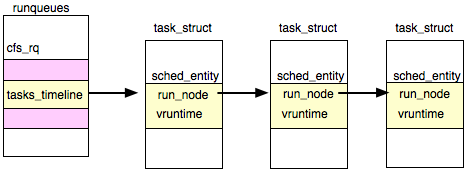
図? runqueueの構造
linux-4.3.3/kernel/sched/sched.h
 555:	struct rq {
...
 583:	        struct cfs_rq cfs;
 584:	        struct rt_rq rt;
 585:	        struct dl_rq dl;
...
 687:	};

 343:	struct cfs_rq {
...
 353:	        struct rb_root tasks_timeline;
 354:	        struct rb_node *rb_leftmost;
...
 420:	};

linux-4.3.3/kernel/sched/core.c
  94:	DEFINE_PER_CPU_SHARED_ALIGNED(struct rq, runqueues);
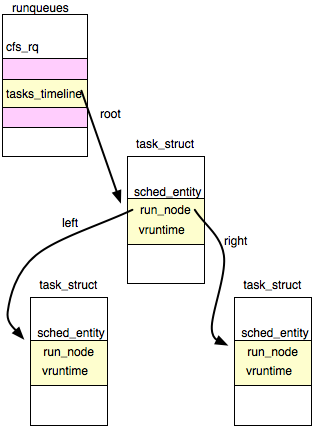
図? runqueueの構造(red-black tree)
linux-4.3.3/kernel/sched/fair.c
 486:	static void __enqueue_entity(struct cfs_rq *cfs_rq, struct sched_entity *se)
 487:	{
 488:	        struct rb_node **link = &cfs_rq->tasks_timeline.rb_node;
 489:	        struct rb_node *parent = NULL;
 490:	        struct sched_entity *entry;
 491:	        int leftmost = 1;
 492:
 493:	        /*
 494:	         * Find the right place in the rbtree:
 495:	         */
 496:	        while (*link) {
 497:	                parent = *link;
 498:	                entry = rb_entry(parent, struct sched_entity, run_node);
 499:	                /*
 500:	                 * We dont care about collisions. Nodes with
 501:	                 * the same key stay together.
 502:	                 */
 503:	                if (entity_before(se, entry)) {
 504:	                        link = &parent->rb_left;
 505:	                } else {
 506:	                        link = &parent->rb_right;
 507:	                        leftmost = 0;
 508:	                }
 509:	        }
 510:
 511:	        /*
 512:	         * Maintain a cache of leftmost tree entries (it is frequently
 513:	         * used):
 514:	         */
 515:	        if (leftmost)
 516:	                cfs_rq->rb_leftmost = &se->run_node;
 517:
 518:	        rb_link_node(&se->run_node, parent, link);
 519:	        rb_insert_color(&se->run_node, &cfs_rq->tasks_timeline);
 520:	}

 451:	static inline int entity_before(struct sched_entity *a,
 452:	                                struct sched_entity *b)
 453:	{
 454:	        return (s64)(a->vruntime - b->vruntime) < 0;
 455:	}
&parent->rb_left), 大きければ右(&parent->rb_right) に進む。
cfs_rq->rb_leftmost にも保存。
linux-4.3.3/kernel/sched/core.c
2813:	void scheduler_tick(void)
2814:	{
2815:	        int cpu = smp_processor_id();
2816:	        struct rq *rq = cpu_rq(cpu);
2817:	        struct task_struct *curr = rq->curr;
...
2823:	        curr->sched_class->task_tick(rq, curr, 0);
...
2835:	}
linux-4.3.3/kernel/sched/fair.c
7804:	static void task_tick_fair(struct rq *rq, struct task_struct *curr, int queued)
7805:	{
7806:	        struct cfs_rq *cfs_rq;
7807:	        struct sched_entity *se = &curr->se;
7808:
7809:	        for_each_sched_entity(se) {
7810:	                cfs_rq = cfs_rq_of(se);
7811:	                entity_tick(cfs_rq, se, queued);
7812:	        }
...
7816:	}

3224:	static void
3225:	entity_tick(struct cfs_rq *cfs_rq, struct sched_entity *curr, int queued)
3226:	{
...
3230:	        update_curr(cfs_rq);
...
3257:	}

 700:	static void update_curr(struct cfs_rq *cfs_rq)
 701:	{
 702:	        struct sched_entity *curr = cfs_rq->curr;
 703:	        u64 now = rq_clock_task(rq_of(cfs_rq));
 704:	        u64 delta_exec;
...
 709:	        delta_exec = now - curr->exec_start;
...
 713:	        curr->exec_start = now;
...
 718:	        curr->sum_exec_runtime += delta_exec;
...
 721:	        curr->vruntime += calc_delta_fair(delta_exec, curr);
...
 733:	}

 596:	static inline u64 calc_delta_fair(u64 delta, struct sched_entity *se)
 597:	{
 598:	        if (unlikely(se->load.weight != NICE_0_LOAD))
 599:	                delta = __calc_delta(delta, NICE_0_LOAD, &se->load);
 600:
 601:	        return delta;
 602:	}
$ cat /proc/sched_debug
Sched Debug Version: v0.09, 2.6.32-431.3.1.el6.x86_64 #1
now at 7955627655.961573 msecs
  .jiffies                                 : 12250294951
...
cpu#0, 2100.000 MHz
  .nr_running                    : 1
...
  .curr->pid                     : 30990
...
cfs_rq[0]:/
  .exec_clock                    : 40812852.059736
...
rt_rq[0]:/
  .rt_nr_running                 : 0
...
  .nr_running                    : 1
...
runnable tasks:
            task   PID         tree-key  switches  prio     exec-runtime         sum-exec        sum-sleep
----------------------------------------------------------------------------------------------------------
R            cat 30990  32644150.029656         2   120  32644150.029656         1.072543         0.366310 /
...
cpu#1, 2100.000 MHz
...
cpu#2, 2100.000 MHz
...
cpu#3, 2100.000 MHz
...
$ cat /proc/self/sched
cat (31354, #threads: 1)
---------------------------------------------------------
se.exec_start                      :    7962193228.073935
se.vruntime                        :      51856286.476132
se.sum_exec_runtime                :             1.211193
...
se.load.weight                     :                 1024
policy                             :                    0
prio                               :                  120
clock-delta                        :                  127
$
void h(int a,int b, int c) {
   ....
}
これを実現するために、どのようなコードを書けばよいか。以下の空欄を埋め
なさい。
struct timer_list my_timer;

int my_arg_a,my_arg_b,my_arg_c;

void f(unsigned long data) {
    init_timer( /*空欄(a)*/ );
    my_timer.expires  = /*空欄(b)*/;
    my_timer.data     = 0;
    my_timer.function = /*空欄(c)*/;
    /*空欄(d)*/;
}

void my_timer_func(unsigned long data) {
     h( my_arg_a,my_arg_b,my_arg_c );
}

図? 4つの要素を持つリスト構造
注意: 正しい二分探索木は、複数存在する。