					2014年01月30日
情報科学類 オペレーティングシステム II

                                       筑波大学 システム情報工学研究科
                                       コンピュータサイエンス専攻, 電子・情報工学系
                                       新城 靖
                                       <yas@cs.tsukuba.ac.jp>
このページは、次の URL にあります。
http://www.coins.tsukuba.ac.jp/~yas/coins/os2-2013/2014-01-30
あるいは、次のページから手繰っていくこともできます。
http://www.coins.tsukuba.ac.jp/~yas/
http://www.cs.tsukuba.ac.jp/~yas/
試験について
linux-3.12.6/kernel/sys.c

 227:	/*
 228:	 * Ugh. To avoid negative return values, "getpriority()" will
 229:	 * not return the normal nice-value, but a negated value that
 230:	 * has been offset by 20 (ie it returns 40..1 instead of -20..19)
 231:	 * to stay compatible.
 232:	 */
 233:	SYSCALL_DEFINE2(getpriority, int, which, int, who)
 234:	{
 235:	        struct task_struct *g, *p;
 236:	        struct user_struct *user;
 237:	        const struct cred *cred = current_cred();
 238:	        long niceval, retval = -ESRCH;
 239:	        struct pid *pgrp;
 240:	        kuid_t uid;
 241:
 242:	        if (which > PRIO_USER || which < PRIO_PROCESS)
 243:	                return -EINVAL;
...
 247:	        switch (which) {
 248:	                case PRIO_PROCESS:
 249:	                        if (who)
 250:	                                p = find_task_by_vpid(who);
 251:	                        else
 252:	                                p = current;
 253:	                        if (p) {
 254:	                                niceval = 20 - task_nice(p);
 255:	                                if (niceval > retval)
 256:	                                        retval = niceval;
 257:	                        }
 258:	                        break;
 259:	                case PRIO_PGRP:
...
 259:	                case PRIO_PGRP:
...
 270:	                case PRIO_USER:
...
 289:	        }
...
 294:	        return retval;
 295:	}

linux-3.12.6/include/linux/sched/rt.h
  17:	#define MAX_USER_RT_PRIO        100
  18:	#define MAX_RT_PRIO             MAX_USER_RT_PRIO
  19:
  20:	#define MAX_PRIO                (MAX_RT_PRIO + 40)
  21:	#define DEFAULT_PRIO            (MAX_RT_PRIO + 20)

linux-3.12.6/kernel/sched/sched.h
  28:	#define NICE_TO_PRIO(nice)      (MAX_RT_PRIO + (nice) + 20)
  29:	#define PRIO_TO_NICE(prio)      ((prio) - MAX_RT_PRIO - 20)
  30:	#define TASK_NICE(p)            PRIO_TO_NICE((p)->static_prio)

linux-3.12.6/kernel/sched/core.c
3200:	int task_nice(const struct task_struct *p)
3201:	{
3202:	        return TASK_NICE(p);
3203:	}
解決策:
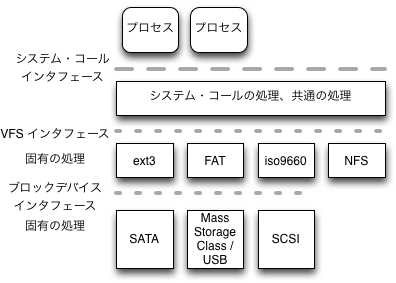
図? ファイル・システム実現に置ける層構造
ディスク・キャッシュの層もある。解決策
$ ls -l /bin/{gunzip,gzip,zcat} ![[←]](../icons/screen-return.gif) -rwxr-xr-x 3 root root 62872 Jan 21 2010 /bin/gunzip
-rwxr-xr-x 3 root root 62872 Jan 21 2010 /bin/gzip
-rwxr-xr-x 3 root root 62872 Jan 21 2010 /bin/zcat
$ ls -li /bin/{gunzip,gzip,zcat}
5636134 -rwxr-xr-x 3 root root 62872 Jan 21 2010 /bin/gunzip
5636134 -rwxr-xr-x 3 root root 62872 Jan 21 2010 /bin/gzip
5636134 -rwxr-xr-x 3 root root 62872 Jan 21 2010 /bin/zcat
$
-rwxr-xr-x 3 root root 62872 Jan 21 2010 /bin/gunzip
-rwxr-xr-x 3 root root 62872 Jan 21 2010 /bin/gzip
-rwxr-xr-x 3 root root 62872 Jan 21 2010 /bin/zcat
$ ls -li /bin/{gunzip,gzip,zcat}
5636134 -rwxr-xr-x 3 root root 62872 Jan 21 2010 /bin/gunzip
5636134 -rwxr-xr-x 3 root root 62872 Jan 21 2010 /bin/gzip
5636134 -rwxr-xr-x 3 root root 62872 Jan 21 2010 /bin/zcat
$ ![[]](../icons/screen-cursor.gif)
$ cat /etc/fstab
LABEL=/                 /                       ext3    defaults        1 1
tmpfs                   /dev/shm                tmpfs   defaults        0 0
devpts                  /dev/pts                devpts  gid=5,mode=620  0 0
sysfs                   /sys                    sysfs   defaults        0 0
proc                    /proc                   proc    defaults        0 0
LABEL=SWAP-sda3         swap                    swap    defaults        0 0
130.158.86.2:/vol/vol1/home     /home   nfs     rw,hard,bg,nfsvers=3,intr      0 0
130.158.86.2:/vol/vol5/local3   /usr/local3     nfs     rw,hard,bg,nfsvers=3,intr       0 0
$ df -h
Filesystem            Size  Used Avail Use% Mounted on
/dev/sda2             222G   13G  198G   6% /
tmpfs                 2.0G     0  2.0G   0% /dev/shm
130.158.86.2:/vol/vol1/home
                      4.0T  1.5T  2.5T  38% /home
130.158.86.2:/vol/vol5/local3
                       80G  4.9G   76G   7% /usr/local3
$
STAT(2)                    Linux Programmer's Manual                   STAT(2)
...
       int stat(const char *path, struct stat *buf);
...
          struct stat {
              dev_t     st_dev;     /* ID of device containing file */
              ino_t     st_ino;     /* inode number */
              mode_t    st_mode;    /* protection */
              nlink_t   st_nlink;   /* number of hard links */
              uid_t     st_uid;     /* user ID of owner */
              gid_t     st_gid;     /* group ID of owner */
              dev_t     st_rdev;    /* device ID (if special file) */
              off_t     st_size;    /* total size, in bytes */
              blksize_t st_blksize; /* blocksize for filesystem I/O */
              blkcnt_t  st_blocks;  /* number of blocks allocated */
              time_t    st_atime;   /* time of last access */
              time_t    st_mtime;   /* time of last modification */
              time_t    st_ctime;   /* time of last status change */
          };
stat コマンドを使うと stat システム・コールで返される値に近いものが表示
される。
$ ls -l .bashrc
-rw-r--r-- 1 yas prof 199 Jun 16  2010 .bashrc
$ stat .bashrc
  File: .bashrc
  Size: 199		Blocks: 8          IO Block: 8192   regular file
Device: 18h/24d		Inode: 29525858    Links: 1
Access: (0644/-rw-r--r--)  Uid: ( 1013/     yas)   Gid: (  510/    prof)
Access: 2014-01-29 21:54:39.920338000 +0900
Modify: 2010-06-16 16:35:05.146214000 +0900
Change: 2010-06-16 16:35:05.146214000 +0900
$
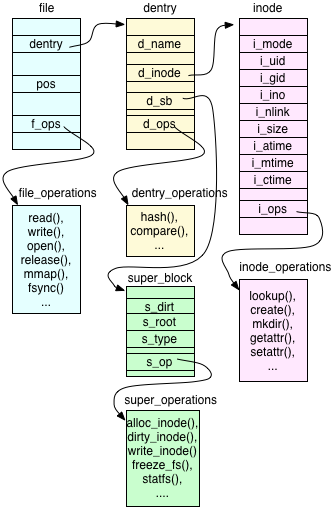
図? スーパーブロック、inode、dentry、file
    int fd1 = open("file1");
    int fd2 = open("file1");
ファイル名 "file1" で表現されるファイルの inode 構造体は、1 個でも、
file 構造体は、2 個割り当てられる。
ディスク上には対応するデータ構造は存在しない。
linux-3.12.6/include/linux/fs.h

 766:	struct file {
...
 776:	        struct path             f_path;
 777:	#define f_dentry        f_path.dentry
 778:	        struct inode            *f_inode;       /* cached value */
 779:	        const struct file_operations    *f_op;
...
 789:	        atomic_long_t           f_count;
...
 791:	        fmode_t                 f_mode;
 792:	        loff_t                  f_pos;
...
 802:	        void                    *private_data;
...
 813:	};
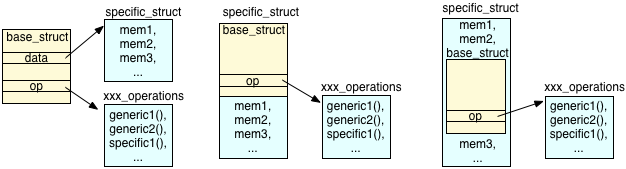
図? C言語によるオブジェクト指向の継承の実装方法。共通インスタンス変数・関数、固有インスタンス変数関数の置き方
struct fileの操作は、たとえば次のような形で行われる。 第1引数は、struct file *。
    struct file *file;
    file->f_op->read(file, buf, count, pos);
f_op には、次のような手続きがある。各ファイルシステム
(ext4,nfs,tmpfs,...) ごとに、手続きの実体は異なるが、インタフェースは同じ。
linux-3.12.6/include/linux/fs.h

1526:	struct file_operations {
1527:	        struct module *owner;
1528:	        loff_t (*llseek) (struct file *, loff_t, int);
1529:	        ssize_t (*read) (struct file *, char __user *, size_t, loff_t *);
1530:	        ssize_t (*write) (struct file *, const char __user *, size_t, loff_t *);
1531:	        ssize_t (*aio_read) (struct kiocb *, const struct iovec *, unsigned long, loff_t);
1532:	        ssize_t (*aio_write) (struct kiocb *, const struct iovec *, unsigned long, loff_t);
1533:	        int (*iterate) (struct file *, struct dir_context *);
1534:	        unsigned int (*poll) (struct file *, struct poll_table_struct *);
1535:	        long (*unlocked_ioctl) (struct file *, unsigned int, unsigned long);
1536:	        long (*compat_ioctl) (struct file *, unsigned int, unsigned long);
1537:	        int (*mmap) (struct file *, struct vm_area_struct *);
1538:	        int (*open) (struct inode *, struct file *);
1539:	        int (*flush) (struct file *, fl_owner_t id);
1540:	        int (*release) (struct inode *, struct file *);
1541:	        int (*fsync) (struct file *, loff_t, loff_t, int datasync);
1542:	        int (*aio_fsync) (struct kiocb *, int datasync);
1543:	        int (*fasync) (int, struct file *, int);
1544:	        int (*lock) (struct file *, int, struct file_lock *);
1545:	        ssize_t (*sendpage) (struct file *, struct page *, int, size_t, loff_t *, int);
1546:	        unsigned long (*get_unmapped_area)(struct file *, unsigned long, unsigned long, unsigned long, unsigned long);
1547:	        int (*check_flags)(int);
1548:	        int (*flock) (struct file *, int, struct file_lock *);
1549:	        ssize_t (*splice_write)(struct pipe_inode_info *, struct file *, loff_t *, size_t, unsigned int);
1550:	        ssize_t (*splice_read)(struct file *, loff_t *, struct pipe_inode_info *, size_t, unsigned int);
1551:	        int (*setlease)(struct file *, long, struct file_lock **);
1552:	        long (*fallocate)(struct file *file, int mode, loff_t offset,
1553:	                          loff_t len);
1554:	        int (*show_fdinfo)(struct seq_file *m, struct file *f);
1555:	};
主な手続きの意味
linux-3.12.6/include/linux/dcache.h

 106:	struct dentry {
...
 111:	        struct dentry *d_parent;        /* parent directory */
 112:	        struct qstr d_name;
 113:	        struct inode *d_inode;          /* Where the name belongs to - NULL is
 114:	                                         * negative */
...
 118:	        struct lockref d_lockref;       /* per-dentry lock and refcount */
...
 119:	        const struct dentry_operations *d_op;
 120:	        struct super_block *d_sb;       /* The root of the dentry tree */
...
 122:	        void *d_fsdata;                 /* fs-specific data */
...
 129:	                struct list_head d_child;       /* child of parent list */
...
 132:	        struct list_head d_subdirs;     /* our children */
 134:	};

 309:	static inline unsigned d_count(const struct dentry *dentry)
 310:	{
 311:	        return dentry->d_lockref.count;
 312:	}

  31:	 #define HASH_LEN_DECLARE u32 hash; u32 len;
...
  43:	struct qstr {
...
  46:	                        HASH_LEN_DECLARE;
...
  50:	        const unsigned char *name;
  51:	};

 100:	#  define DNAME_INLINE_LEN 40 /* 128 bytes */
linux-3.6.8/include/linux/fs.h

 782:	struct inode {
 783:	        umode_t                 i_mode;
 784:	        unsigned short          i_opflags;
 785:	        kuid_t                  i_uid;
 786:	        kgid_t                  i_gid;
...
 794:	        const struct inode_operations   *i_op;
 795:	        struct super_block      *i_sb;
...
 803:	        unsigned long           i_ino;
...
 812:	                const unsigned int i_nlink;
...
 815:	        dev_t                   i_rdev;
 816:	        loff_t                  i_size;
 817:	        struct timespec         i_atime;
 818:	        struct timespec         i_mtime;
 819:	        struct timespec         i_ctime;
 820:	        spinlock_t              i_lock; /* i_blocks, i_bytes, maybe i_size */
 821:	        unsigned short          i_bytes;
 822:	        unsigned int            i_blkbits;
 823:	        blkcnt_t                i_blocks;
...
 830:	        unsigned long           i_state;
...
 835:	        struct hlist_node       i_hash;
...
 840:	                struct hlist_head       i_dentry;
...
 844:	        atomic_t                i_count;
...
 870:	        void                    *i_private; /* fs or device private pointer */
 871:	};
    struct inode *inode;
    ...
    inode->i_op->create(inode, name, mode, true);
i_op には、次のような手続きがある。各ファイルシステム
(ext3,nfs,tmpfs,...) ごとに、手続きの実体は異なるが、インタフェースは同じ。
linux-3.12.6/include/linux/fs.h

1557:	struct inode_operations {
1558:	        struct dentry * (*lookup) (struct inode *,struct dentry *, unsigned int);
1559:	        void * (*follow_link) (struct dentry *, struct nameidata *);
1560:	        int (*permission) (struct inode *, int);
1561:	        struct posix_acl * (*get_acl)(struct inode *, int);
1562:
1563:	        int (*readlink) (struct dentry *, char __user *,int);
1564:	        void (*put_link) (struct dentry *, struct nameidata *, void *);
1565:
1566:	        int (*create) (struct inode *,struct dentry *, umode_t, bool);
1567:	        int (*link) (struct dentry *,struct inode *,struct dentry *);
1568:	        int (*unlink) (struct inode *,struct dentry *);
1569:	        int (*symlink) (struct inode *,struct dentry *,const char *);
1570:	        int (*mkdir) (struct inode *,struct dentry *,umode_t);
1571:	        int (*rmdir) (struct inode *,struct dentry *);
1572:	        int (*mknod) (struct inode *,struct dentry *,umode_t,dev_t);
1573:	        int (*rename) (struct inode *, struct dentry *,
1574:	                        struct inode *, struct dentry *);
1575:	        int (*setattr) (struct dentry *, struct iattr *);
1576:	        int (*getattr) (struct vfsmount *mnt, struct dentry *, struct kstat *);
1577:	        int (*setxattr) (struct dentry *, const char *,const void *,size_t,int);
1578:	        ssize_t (*getxattr) (struct dentry *, const char *, void *, size_t);
1579:	        ssize_t (*listxattr) (struct dentry *, char *, size_t);
1580:	        int (*removexattr) (struct dentry *, const char *);
1581:	        int (*fiemap)(struct inode *, struct fiemap_extent_info *, u64 start,
1582:	                      u64 len);
1583:	        int (*update_time)(struct inode *, struct timespec *, int);
1584:	        int (*atomic_open)(struct inode *, struct dentry *,
1585:	                           struct file *, unsigned open_flag,
1586:	                           umode_t create_mode, int *opened);
1587:	        int (*tmpfile) (struct inode *, struct dentry *, umode_t);
1588:	} ____cacheline_aligned;
linux-3.12.6/include/linux/fs.h

1243:	struct super_block {
...
1248:	        loff_t                  s_maxbytes;     /* Max file size */
1249:	        struct file_system_type *s_type;
1250:	        const struct super_operations   *s_op;
...
1256:	        struct dentry           *s_root;
...
1265:	        struct list_head        s_inodes;       /* all inodes */
...
1284:	        void                    *s_fs_info;     /* Filesystem private info */
...
1331:	        struct list_lru         s_dentry_lru ____cacheline_aligned_in_smp;
1332:	        struct list_lru         s_inode_lru ____cacheline_aligned_in_smp;
1333:	};
p->files->fd_array[fd] の struct file を表
す。
linux-3.12.6/include/linux/sched.h

1023:	struct task_struct {
...
1203:	        struct files_struct *files;
...
1414:	};

linux-3.12.6/include/linux/fdtable.h
  45:	struct files_struct {
...
  59:	        struct file __rcu * fd_array[NR_OPEN_DEFAULT];
  60:	};
![図? p->files->fd_array[fd]](images/task-files-file-dentry-inode.png)
図? task_struct、ファイル記述子、file構造体、その他
linux-3.12.6/fs/read_write.c

 499:	SYSCALL_DEFINE3(read, unsigned int, fd, char __user *, buf, size_t, count)
 500:	{
 501:	        struct fd f = fdget(fd);
 502:	        ssize_t ret = -EBADF;
 503:
 504:	        if (f.file) {
 505:	                loff_t pos = file_pos_read(f.file);
 506:	                ret = vfs_read(f.file, buf, count, &pos);
 507:	                if (ret >= 0)
 508:	                        file_pos_write(f.file, pos);
 509:	                fdput(f);
 510:	        }
 511:	        return ret;
 512:	}

linux-3.12.6/include/linux/file.h
  29:	struct fd {
  30:	        struct file *file;
  31:	        int need_put;
  32:	};
linux-3.12.6/fs/read_write.c

 381:	ssize_t vfs_read(struct file *file, char __user *buf, size_t count, loff_t *pos)
 382:	{
 383:	        ssize_t ret;
 384:
 385:	        if (!(file->f_mode & FMODE_READ))
 386:	                return -EBADF;
 387:	        if (!file->f_op || (!file->f_op->read && !file->f_op->aio_read))
 388:	                return -EINVAL;
 389:	        if (unlikely(!access_ok(VERIFY_WRITE, buf, count)))
 390:	                return -EFAULT;
 391:
 392:	        ret = rw_verify_area(READ, file, pos, count);
 393:	        if (ret >= 0) {
 394:	                count = ret;
 395:	                if (file->f_op->read)
 396:	                        ret = file->f_op->read(file, buf, count, pos);
 397:	                else
 398:	                        ret = do_sync_read(file, buf, count, pos);
 399:	                if (ret > 0) {
 400:	                        fsnotify_access(file);
 401:	                        add_rchar(current, ret);
 402:	                }
 403:	                inc_syscr(current);
 404:	        }
 405:
 406:	        return ret;
 407:	}
linux-3.12.6/fs/ext4/file.c

 593:	const struct file_operations ext4_file_operations = {
 594:	        .llseek         = ext4_llseek,
 595:	        .read           = do_sync_read,
 596:	        .write          = do_sync_write,
 597:	        .aio_read       = generic_file_aio_read,
 598:	        .aio_write      = ext4_file_write,
 599:	        .unlocked_ioctl = ext4_ioctl,
 600:	#ifdef CONFIG_COMPAT
 601:	        .compat_ioctl   = ext4_compat_ioctl,
 602:	#endif
 603:	        .mmap           = ext4_file_mmap,
 604:	        .open           = ext4_file_open,
 605:	        .release        = ext4_release_file,
 606:	        .fsync          = ext4_sync_file,
 607:	        .splice_read    = generic_file_splice_read,
 608:	        .splice_write   = generic_file_splice_write,
 609:	        .fallocate      = ext4_fallocate,
 610:	};
 611:
 612:	const struct inode_operations ext4_file_inode_operations = {
...
 621:	};
 622:

linux-3.12.6/fs/ext4/super.c
1081:	static const struct super_operations ext4_sops = {
...
1100:	};
linux-3.12.6/fs/ext4/ext4.h

 802:	struct ext4_inode_info {
...
 860:	        struct inode vfs_inode;
...
 929:	};
...
1323:	static inline struct ext4_inode_info *EXT4_I(struct inode *inode)
1324:	{
1325:	        return container_of(inode, struct ext4_inode_info, vfs_inode);
1326:	}

linux-3.12.6/include/linux/kernel.h
 785:	/**
 786:	 * container_of - cast a member of a structure out to the containing structure
 787:	 * @ptr:        the pointer to the member.
 788:	 * @type:       the type of the container struct this is embedded in.
 789:	 * @member:     the name of the member within the struct.
 790:	 *
 791:	 */
 792:	#define container_of(ptr, type, member) ({                      \
 793:	        const typeof( ((type *)0)->member ) *__mptr = (ptr);    \
 794:	        (type *)( (char *)__mptr - offsetof(type,member) );}
 795:
 796:	/* Trap pasters of __FUNCTION__ at compile-time */
)
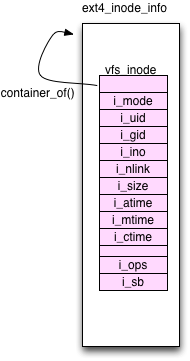
図? Ext4 ファイルシステムで使う構造体 ext4_inode_info での struct inode の保持
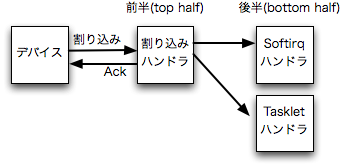
図? 割り込み処理の前半部分と後半部分
割り込みハンドラ(前半部)と後半部の役割分担の目安。
注意1: Tasklet は、task 構造体とはまったく関係ない。名前がよくない。
注意2: Softirq という用語を、割り込み処理の後半部という意味で使う人もい る。
注意3: 伝統的なUnixでは、top half は、システム・コールから派生する上位 層の処理、bottom half は、割り込みから派生する下位層の処理の意味で使わ れることがある。Linux では、top half, bottom half は、割り込み処理の前 半部分と後半部分の意味に使う。
Tasklet で1つの仕事は次のような、struct tasklet_struct で表現される。
linux-3.12.6/include/linux/interrupt.h
 431:	struct tasklet_struct
 432:	{
 433:	        struct tasklet_struct *next;
 434:	        unsigned long state;
 435:	        atomic_t count;
 436:	        void (*func)(unsigned long);
 437:	        unsigned long data;
 438:	};
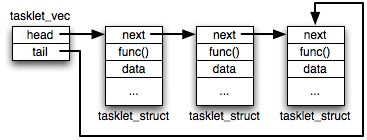
図? Taskletにおける仕事のキュー
DECLARE_TASKLET(name, func, data)
    有効な(count==0) の struct tasklet_struct を宣言する

DECLARE_TASKLET_DISABLED(name, func, data)
    無効な(count==1) の struct tasklet_struct を宣言する
void tasklet_init(struct tasklet_struct *t,
    void (*func)(unsigned long), unsigned long data);
その他に、生成消滅有効無効に関して次のような操作がある。
void tasklet_handler(unsigned long data) {
    ....
}
void tasklet_schedule(struct tasklet_struct *t)
    Tasklet t を通常の優先度でスケジュールする

void tasklet_hi_schedule(struct tasklet_struct *t)
    Tasklet t を高優先度でスケジュールする
すると、それは「そのうちに」1度だけ実行される。
linux-3.12.6/drivers/net/wireless/ath/ath9k/ath9k.h
 697:	struct ath_softc {
...
 704:	        struct tasklet_struct intr_tq;
 705:	        struct tasklet_struct bcon_tasklet;
...
 777:	};

linux-3.12.6/drivers/net/wireless/ath/ath9k/init.c
 675:	        tasklet_init(&sc->intr_tq, ath9k_tasklet, (unsigned long)sc);
 676:	        tasklet_init(&sc->bcon_tasklet, ath9k_beacon_tasklet,
 677:	                     (unsigned long)sc);
linux-3.12.6/drivers/net/wireless/ath/ath9k/main.c

 421:	irqreturn_t ath_isr(int irq, void *dev)
 422:	{
..
 441:	        enum ath9k_int status;
...
 468:	        ath9k_hw_getisr(ah, &status);   /* NB: clears ISR too */
 469:	        status &= ah->imask;    /* discard unasked-for bits */
...
 511:	        if (status & ATH9K_INT_SWBA)
 512:	                tasklet_schedule(&sc->bcon_tasklet);
...
 539:	        if (sched) {
 540:	                /* turn off every interrupt */
 541:	                ath9k_hw_disable_interrupts(ah);
 542:	                tasklet_schedule(&sc->intr_tq);
 543:	        }
 544:
 545:	        return IRQ_HANDLED;
...
 548:	}

 353:	void ath9k_tasklet(unsigned long data)
 354:	{
...
 419:	}

linux-3.12.6/drivers/net/wireless/ath/ath9k/beacon.c
 311:	void ath9k_beacon_tasklet(unsigned long data)
 312:	{
...
 412:	}
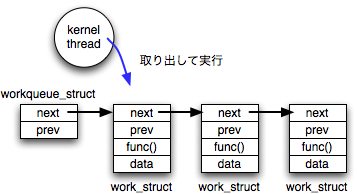
キューにつながれる仕事は、Tasklet の仕事とほとんど同じで、関数へのポイ ンタ func と data からなる。処理の主体が、ワーカ・スレッドと呼ばれるカー ネル・レベルのスレッドである所が違う。
$ ps alx
F   UID   PID  PPID PRI  NI    VSZ   RSS WCHAN  STAT TTY        TIME COMMAND
...
1     0     5     2   0 -20      0     0 worker S<   ?          0:00 [kworker/0:0H]
1     0     6     2  20   0      0     0 worker S    ?          0:00 [kworker/u:0]
1     0     7     2   0 -20      0     0 worker S<   ?          0:00 [kworker/u:0H]
1     0    27     2  20   0      0     0 worker S    ?          0:00 [kworker/u:1]
1     0   367     2   0 -20      0     0 worker S<   ?          0:00 [kworker/0:1H]
1     0   650     2   0 -20      0     0 worker S<   ?          0:00 [kworker/u:1H]
...
1     0 29461     2  20   0      0     0 worker S    ?          0:00 [kworker/0:1]
1     0 29482     2  20   0      0     0 worker S    ?          0:00 [kworker/0:2]
1     0 29503     2  20   0      0     0 worker S    ?          0:00 [kworker/0:0]
1     0 29601     2  20   0      0     0 worker S    ?          0:00 [kworker/0:3]
$
汎用の Work Queue のワーカ・スレッドの他に、専用のワーカ・スレッドを作
ることもできる。
linux-3.6.8/include/linux/workqueue.h

  18:	typedef void (*work_func_t)(struct work_struct *work);

  79:	struct work_struct {
  80:	        atomic_long_t data;
  81:	        struct list_head entry;
  82:	        work_func_t func;
...
  86:	};
struct work_struct my_work;
...
INIT_WORK(&my_work,my_work_handler);
void my_work_handler(struct work_struct *work)
{
...
}
schedule_work(&work);
この結果、INIT_WORK() で設定したハンドラがワーカ・スレッドにより「その
うち」に呼び出される。
schedule_work() では、即座に実行される可能性もある。少し後に実行したい (間を取りたい)時には、次の関数を呼ぶ。
schedule_delayed_work(&work,ticks);
ticks は、どのくらい間をとるか。単位は、
ticks (jiffiesの単位)。
多くのシステムで10ミリ秒-1ミリ秒で、設定によって異なる。
ssize_t vfs_write(struct file *file, const char __user *buf, size_t count, loff_t *pos)
{
	ssize_t ret;
...
	ret = rw_verify_area(WRITE, file, pos, count);
	if (ret >= 0) {
		count = ret;
		file_start_write(file);
		if (file->f_op->/*空欄(a)*/)
			ret = file->f_op->/*空欄(b)*/(/*空欄(c)*/, buf, count, pos);
...
	return ret;
}
void f(int arg1, int arg2) {
   省略;
}
これを実現するために、どのような Tasklet のハンドラと初期化コードを書け
ばよいか。以下の空欄を埋めなさい。
void tasklet_handler(unsigned long data) { /* Tasklet ハンドラ */
    int arg1, arg2;
    arg1 = 省略;
    arg2 = 省略;
    /*空欄(a)*/
    その他の仕事;
}

DECLARE_TASKLET(/*空欄(b)*/, /*空欄(c)*/, 0); /* 構造体の初期化 */
注意: 構造体の名前は、次の問題の解答で利用する。それらしいものを付けな
さい。
irqreturn_t irq_handler(int irq, void *dev) {
    /*空欄(d)*/
    return IRQ_HANDLED;
}